

By Milly · Phuket Property Guide · WARM+
“The villa is priced at THB 20 million. How much more should I set aside for the transfer?”
It is a question clients often ask. Some have heard that transfer costs are around 6%; others have been told that buyer and seller pay half each, without being told exactly which costs are included.
To calculate the amount properly, start with three questions: Is the seller a company or an individual? How long have they held the property? Are you transferring ownership or registering a lease? Whether the property is new or resale is only part of the answer.
First calculate the taxes and fees for the transaction. Then work out the buyer’s share. Keeping these two steps separate makes the budget much clearer.
1. The four main taxes and fees
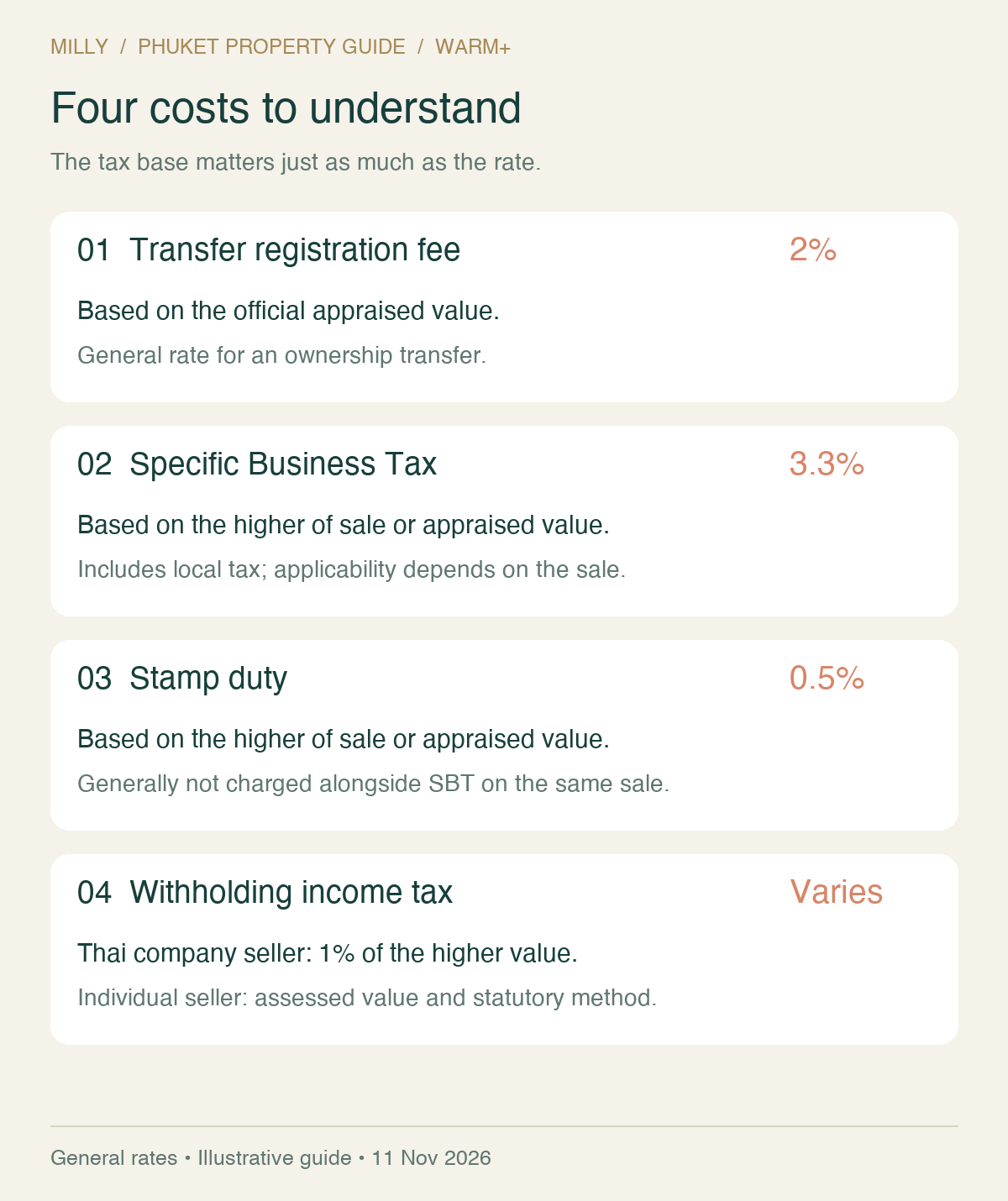
Four common transfer charges under general rules. Sources [1]–[4] and [8]; special exemptions and reductions require a separate check.
Transfer registration fee: generally 2%. This is calculated on the official appraised value, which may differ from the agreed sale price. Multiplying the purchase price by 2% will not always give the correct figure. [1]
Specific Business Tax (SBT): generally 3.3%, including local tax. The base is the higher of the sale price and official appraised value. It generally applies to company sellers, including developers. For an individual seller, the holding period and any applicable exemption also matter. [3] [4]
Stamp duty: generally 0.5%. This also uses the higher of the sale price and appraised value. On the same property sale, stamp duty is generally not charged in addition to SBT. [3]
Withholding income tax: the seller’s status changes the calculation. For a Thai company seller, the general withholding rate is 1% of the higher of the sale price and appraised value. For an individual seller, the calculation uses the appraised value, acquisition method, holding period and statutory deductions. It is not a flat 1%. [2] [8]
Withholding tax is a payment towards the seller’s income tax. The obligation to withhold and remit it is separate from any agreement about who bears the economic cost.
2. Buying from a developer: what does “half each” mean?
In the Phuket new-build sales quotations our team encounters, including condominium quotations, a common arrangement is to add together the applicable transfer taxes and fees, then quote a 50/50 share for the buyer and developer. In this context, “half each” refers to the quoted total, including the applicable registration fee, SBT and withholding tax—not just the 2% registration fee.
Some developers run promotions in which they cover all transfer taxes and fees, including the portion otherwise allocated to the buyer in their quotation. These offers may apply only to selected units or transfers completed within a specified period.
This describes our experience of sales quotations, rather than a universal legal rule. Any allocation must comply with the rules applicable to the contract; see the condominium contract note at the end of this article.
Ask what the promotion actually covers. A waiver of the 2% registration fee and an offer to cover all transfer taxes and fees are different benefits. Have the eligible unit, covered items and deadline recorded in the quotation and contract documents.
For a worked example, assume a property ownership sale by a Thai company, with SBT payable and no special reductions. The sale price is THB 20 million, while the official appraised value is THB 15 million.
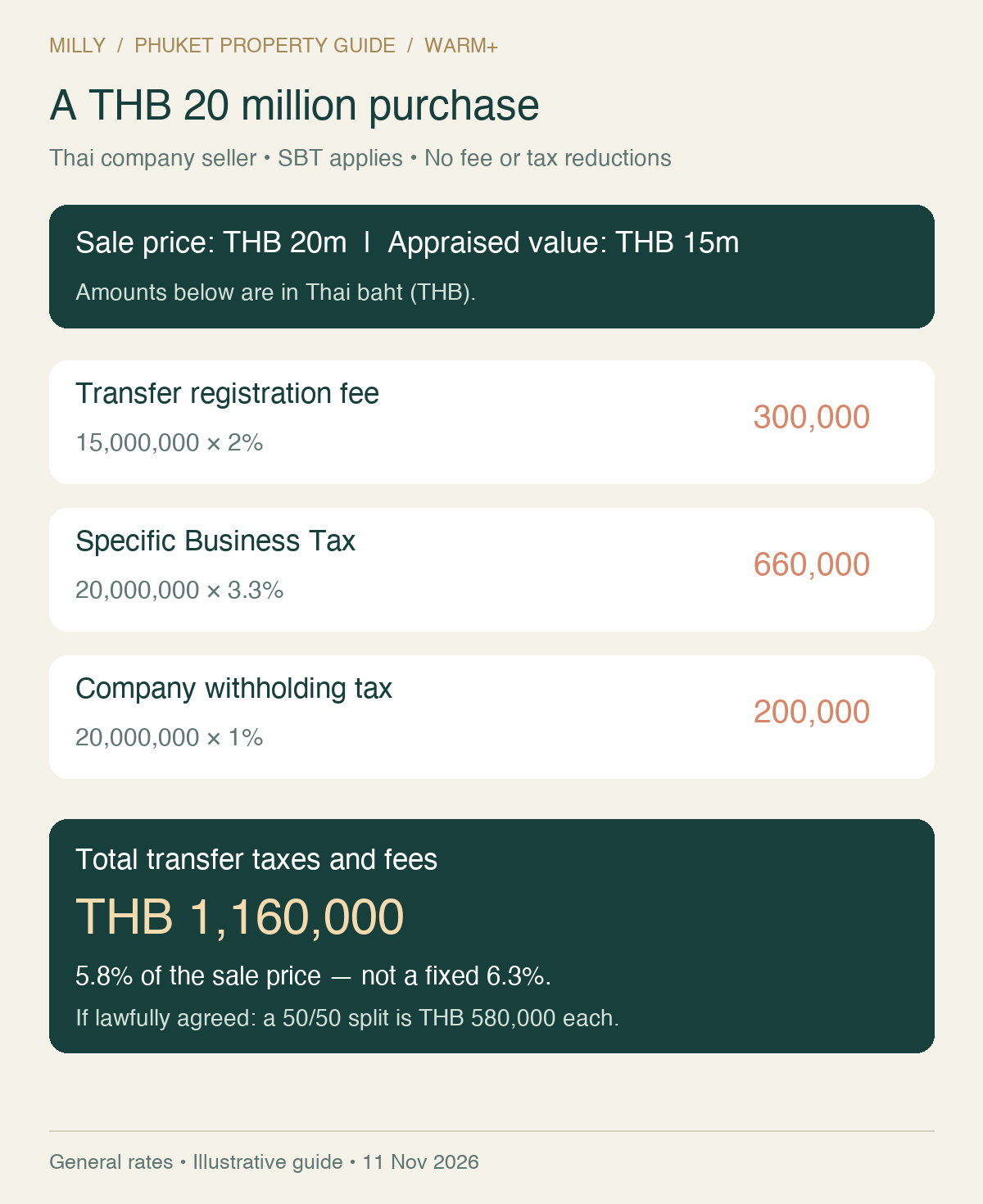
Illustrative calculation: THB 300,000 + THB 660,000 + THB 200,000 = THB 1,160,000. This is not a quotation for a particular property.
If a 50/50 split of all three charges is applicable and lawfully agreed:
Buyer’s share: THB 580,000
Developer’s share: THB 580,000
This excludes legal fees, common-area charges, furniture and other acquisition costs.
Why is the total not simply 6.3% of the purchase price? The 2% registration fee uses the THB 15 million appraised value, while the other two charges use THB 20 million. The three charges total 5.8% of the sale price in this example. Adding 2% + 3.3% + 1% gives a meaningful 6.3% total only when all three apply to the same base, with no relevant reduction.
If the agreement instead shares only the registration fee, with the seller bearing its own taxes, the buyer’s registration-fee share in this example would be THB 150,000. That is why “half each” needs an itemised explanation.
3. Resale villas: who is selling matters as much as how long they have owned it
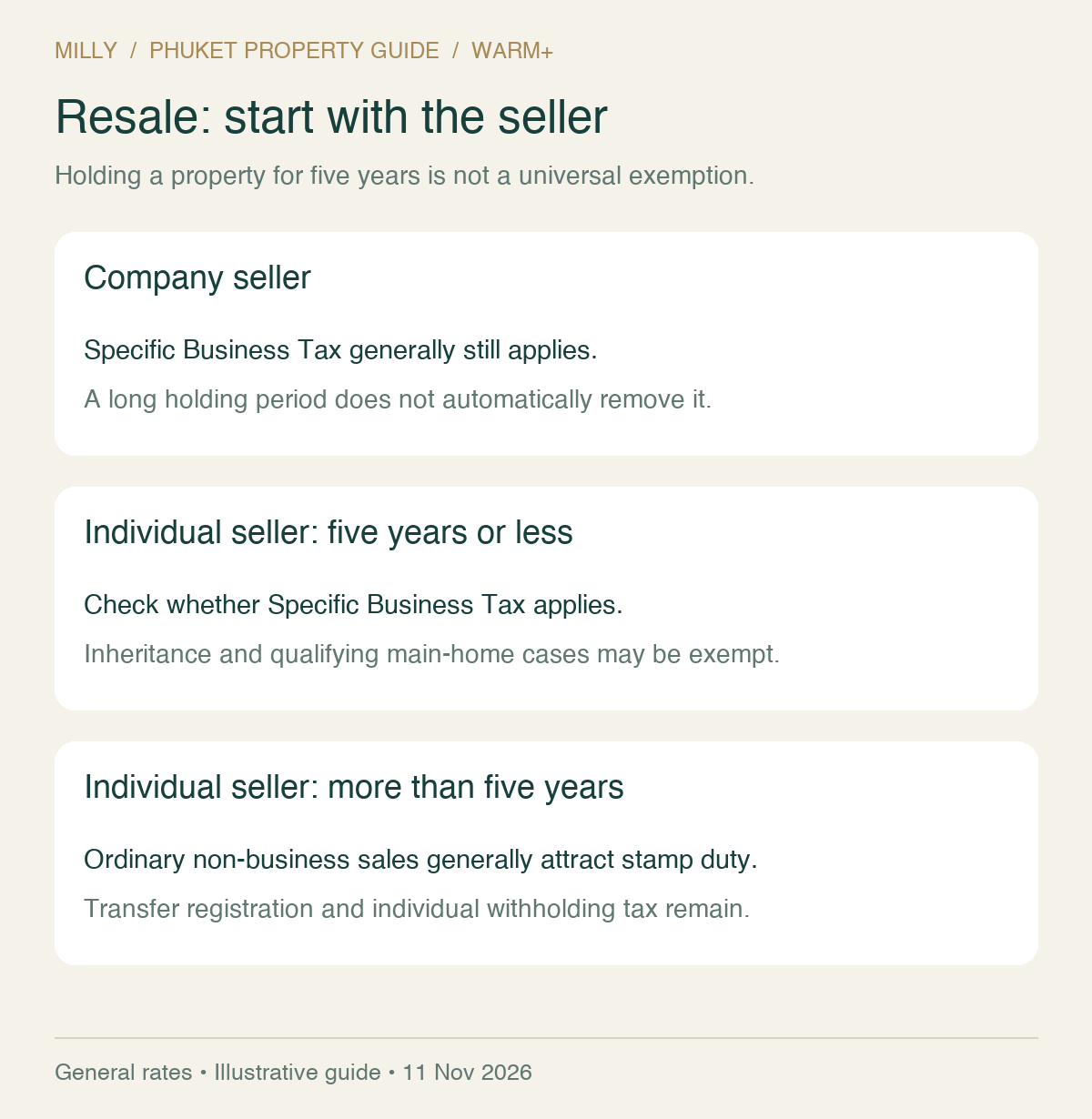
Check the seller’s status before applying a holding-period rule. Individual exemptions have specific conditions. Source [4].
An individual selling within five years. An ordinary sale generally requires an SBT check. Exceptions may apply, including inherited property and qualifying principal-residence cases involving the seller’s name on the house registration for at least one year. [4]
An individual selling after more than five years. An ordinary non-business sale will generally attract stamp duty rather than SBT. The registration fee and individual withholding income tax still need to be calculated. A five-year holding period does not make the entire transaction tax-free. [3] [4]
A company selling a resale property. A company sale generally remains subject to SBT even where the villa has been held for many years. Do not apply the individual seller’s five-year rule automatically to a corporate seller. [4]
When negotiating a resale, I recommend agreeing the price and cost allocation together. Establish what the seller expects to receive and which costs the buyer will pay in addition to the price, then put both into a settlement statement. Individual withholding tax requires the seller’s actual information; a developer-style 1% estimate is not a substitute.
4. Leasehold: what does the familiar 1.1% cover?
Registering a new lease at the Land Office generally involves a 1% registration fee plus 0.1% stamp duty. The base is the rent for the full registered term together with applicable lease premiums or key money, rather than just one year’s rent. [6] [7]
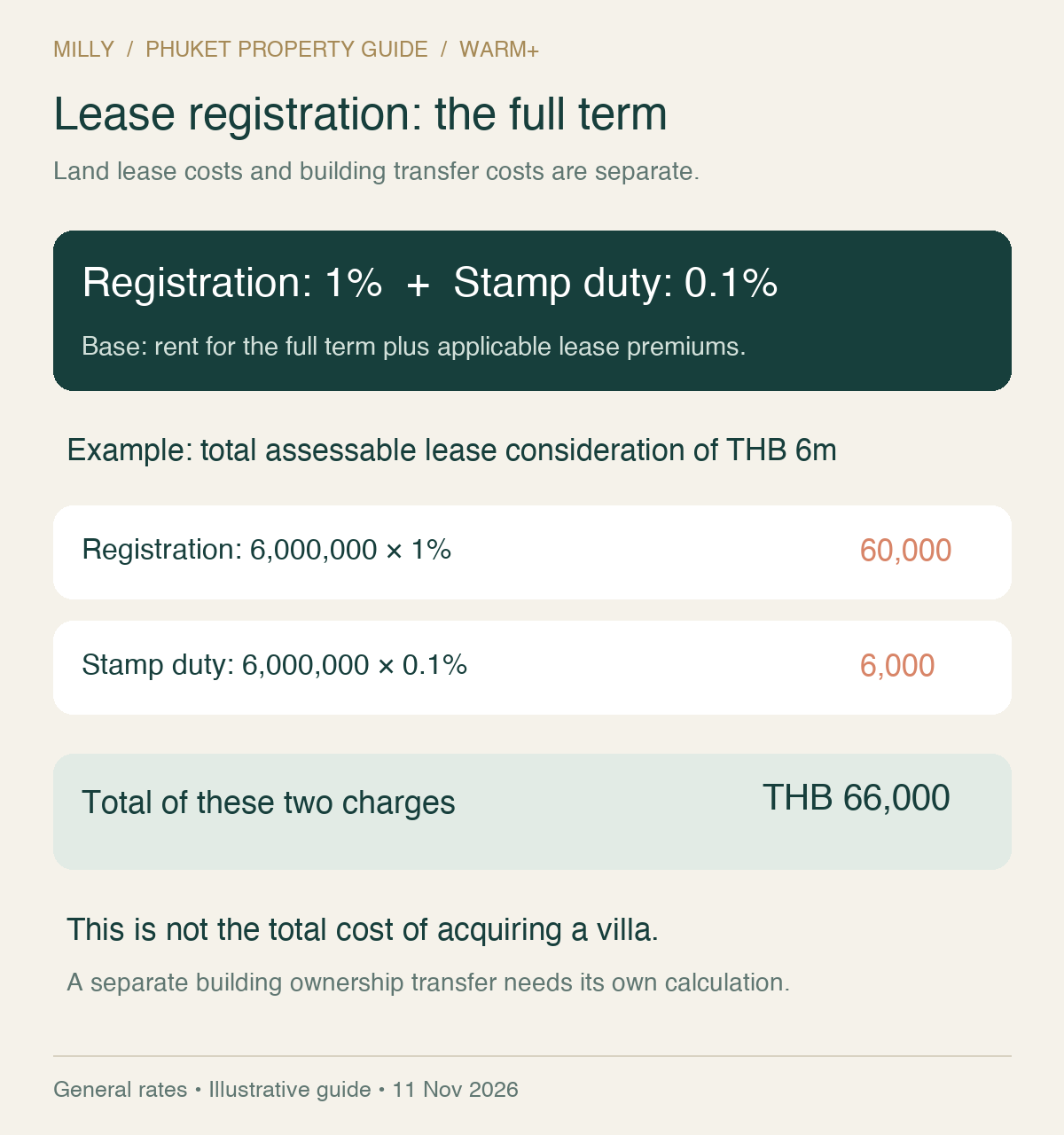
Illustrative lease consideration of THB 6 million produces THB 66,000 in these two charges, excluding minor application charges. Sources [6] and [7].
The lease should state how costs are allocated. Do not assume that landlord and tenant automatically pay half each. The stamp duty schedule identifies the lessor as liable for that duty; a contractual allocation of economic cost should be distinguished from the statutory obligation. [7]
For a villa, separate the land arrangement from the building. Where the transaction involves a land lease and a separate transfer of building ownership, the lease registration and building transfer require separate calculations. Applying 1.1% to the entire villa price can be misleading.
Taking over an existing registered lease also requires a closer look: an assignment, termination followed by a new lease, or another arrangement may involve different costs. Have the calculation based on the documents actually being signed.
5. Four things to settle before payment
Itemise who pays what. List every charge covered by “all taxes and fees,” including whether seller withholding tax is included. Record the precise scope of any waiver in the contract or its attachments, consistently with applicable requirements.
Obtain both values. Confirm the sale price and official appraised value, then use the correct base for each charge. For an individual seller, obtain the acquisition date and acquisition details needed for the tax calculation.
Prepare a complete completion budget. Taxes and fees due for registration are generally settled when the transfer is registered. Confirm payment arrangements in advance and budget separately for legal fees, common-area charges, sinking-fund contributions and any mortgage-related costs. [8]
Check temporary reductions separately. This article uses general rates. Any government concession must be checked against the registration date, buyer’s eligibility, property type and applicable value limits.
Milly’s advice
Compare the purchase price together with the buyer’s additional costs. Two properties with the same asking price can require different completion budgets. Make sure any negotiated saving appears as a specific item in the contract.
If you are considering a Phuket condominium or villa, send the project details, quotation and proposed cost allocation to Milly’s team. We can help organise the transaction details and cost checklist for review with your independent lawyer before you commit.
Sources and scope
Condominium contract note. The 50/50 description above reflects Milly’s experience of sales quotations. Under the applicable developer condominium contract rules described by BOI OSOS, the developer bears income tax, SBT and stamp duty, while registration fees may be shared. A quotation or agreement does not override applicable requirements; have an independent lawyer review any inconsistency. [5]
Information reviewed on 11 November 2026. This is a general guide with original explanatory graphics and hypothetical examples. Exact liabilities, contract enforceability and any reductions should be checked with an independent lawyer or tax adviser against the applicable Land Office requirements.
[1] Thai government: general ownership transfer registration rate
[2] Thai Revenue Department: corporate property-sale withholding tax
[3] Thai Revenue Department: property-sale taxes and calculation bases
[4] Thai government: Specific Business Tax and exemptions
[5] BOI OSOS: developer condominium contract requirements
[6] Thai government service guide: lease registration charges
[7] Thai Revenue Department: stamp duty schedule
[8] Thai Revenue Department: Revenue Code, individual income tax and withholding